Text and Select Photography by Sharon McDonnell
The Allure of the Exotic East
Venetian explorer Marco Polo sparked a fascination with China with his sensational account of his visit in the 13th century. Its allure seized the European imagination and never let go. Its appeal was only strengthened by subsequent traders (first from Portugal in the 16th century and then Holland and England, among others), who imported its porcelain, tea, and silks. The lure of the exotic, mysterious Far East, which most people would never see, led to a romanticized idea of China and its landscapes, people, and animals in the decorative arts, including teaware, furniture, wallpaper, art, and textiles, by Europeans and, later, Americans. Often, the designs in the style dubbed “chinoiserie” (derived from the French word chiniois, meaning “Chinese”) were pure fantasy, featuring palm trees, monkeys, and an empress cultivating pineapples—although China isn’t tropical, except for southernmost regions such as Hainan island.
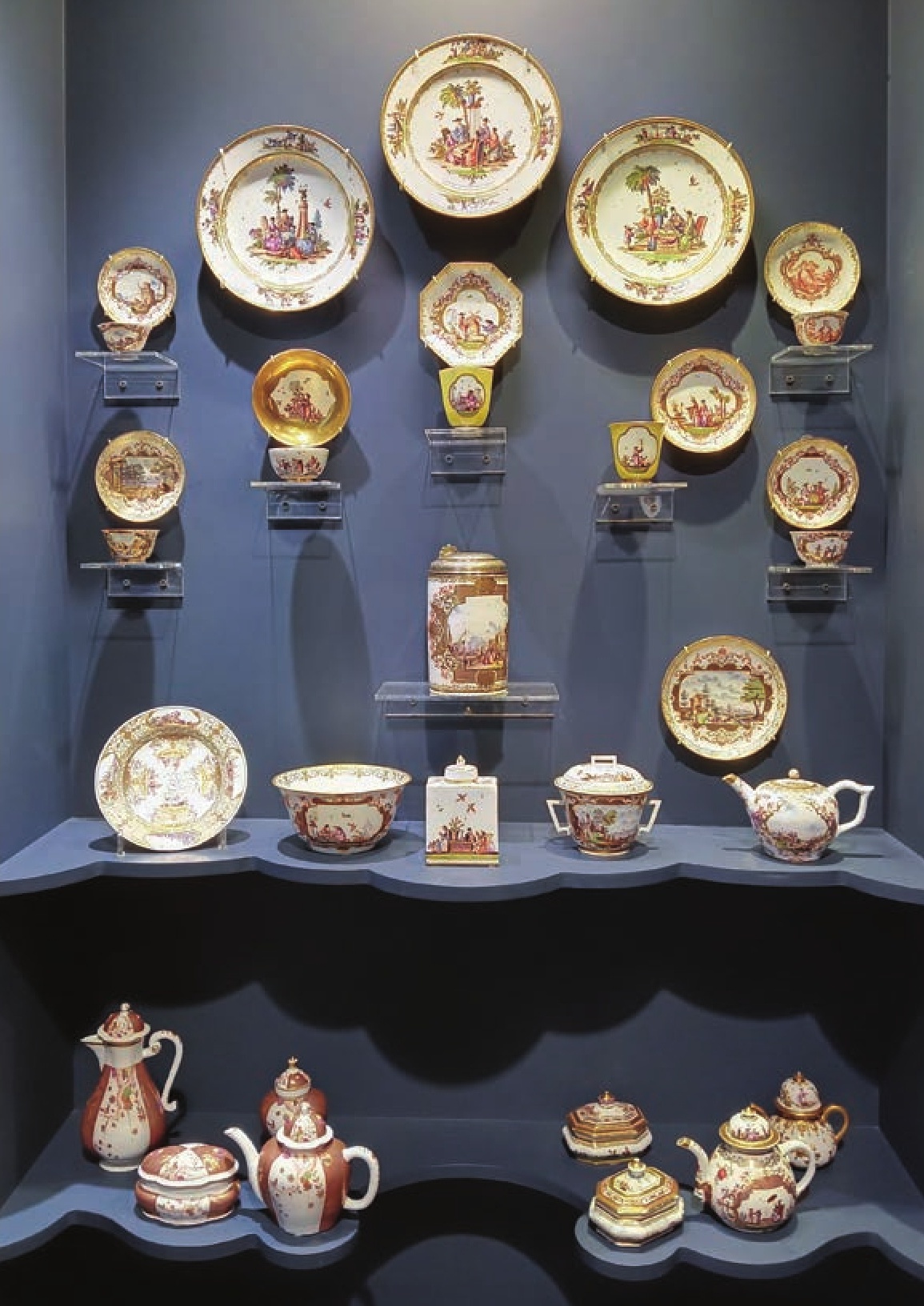
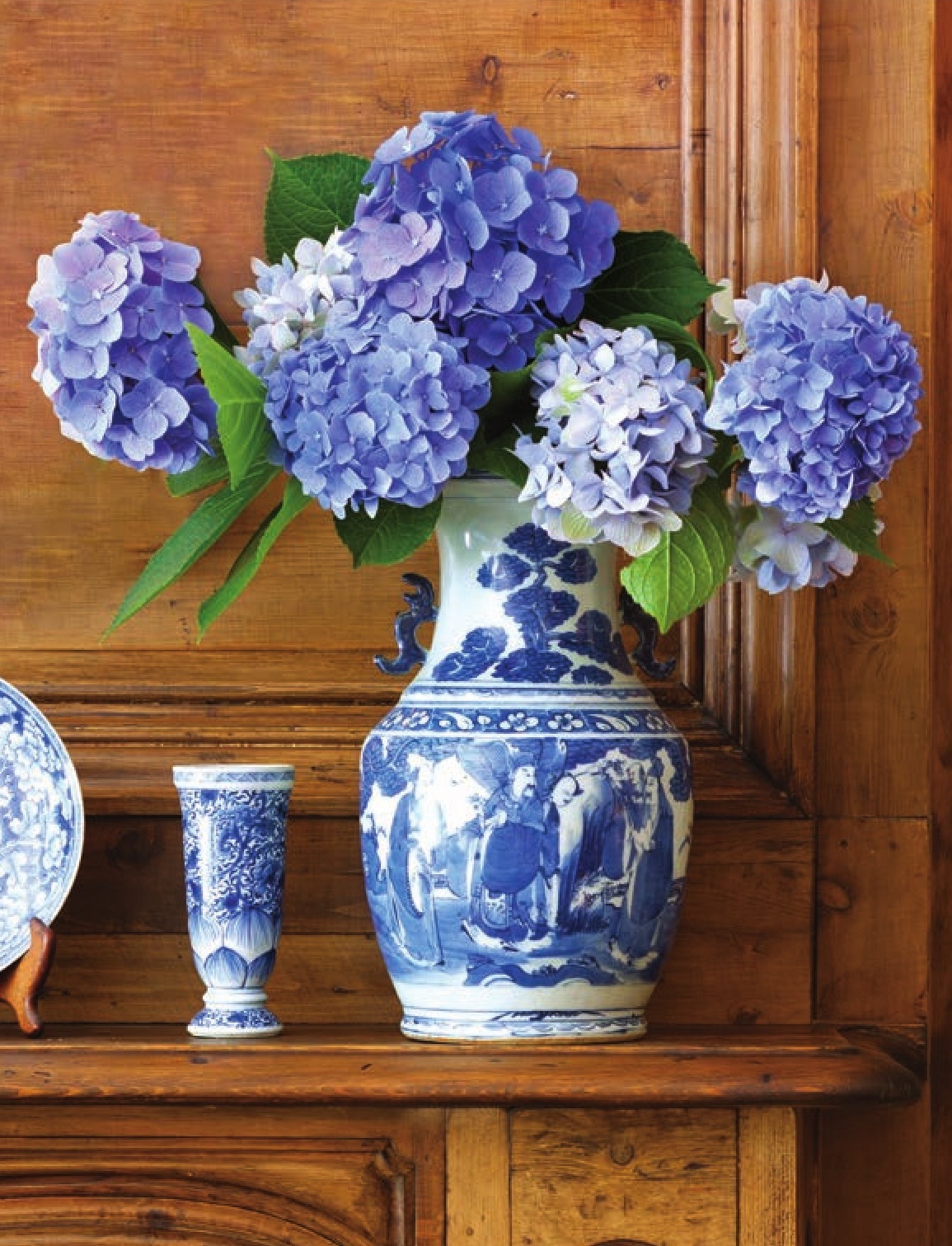
“Chinese porcelains came to represent the pinnacle of taste and refinement,” according to the 2024 exhibit China Blues: The World in Blue and White at the Memphis Brooks Museum of Art. Noted Irish wit and playwright Oscar Wilde once quipped, “I find it harder and harder to live up to my blue china,” which embodied a level of elegance that even he found difficult to maintain. The exhibit’s lovely blue-and-white pieces were on loan from the Belz Museum of Asian & Judaic Art in Memphis, collected by the man who restored the city’s Peabody Hotel, famed for its ducks who parade in its lobby daily.
“I think the blue-and-white porcelain trend is the longest-running trend of all time— it always looks beautiful,” said Aldous Bertram, a British interior designer whose doctorate from Cambridge University is in chinoiserie. His book, Dragons & Pagodas: A Celebration of Chinoiserie, features chapters on porcelain, color and pattern, architecture, flora, fauna, and people.
Splendid examples of chinoiserie in Europe are found everywhere. England’s Buckingham Palace boasts an extensive collection. In Germany, the park surrounding Sanssouci Palace in Potsdam has a Chinese teahouse. In Sweden, Drottningholm Palace, near Stockholm, features a Chinese pavilion. In France, King Louis XIV built Europe’s first chinoiserie structure in 1670, Trianon de Porcelaine, at the Palace of Versailles. It was Germany, however, that was most captivated by chinoiserie, according to Bertram.
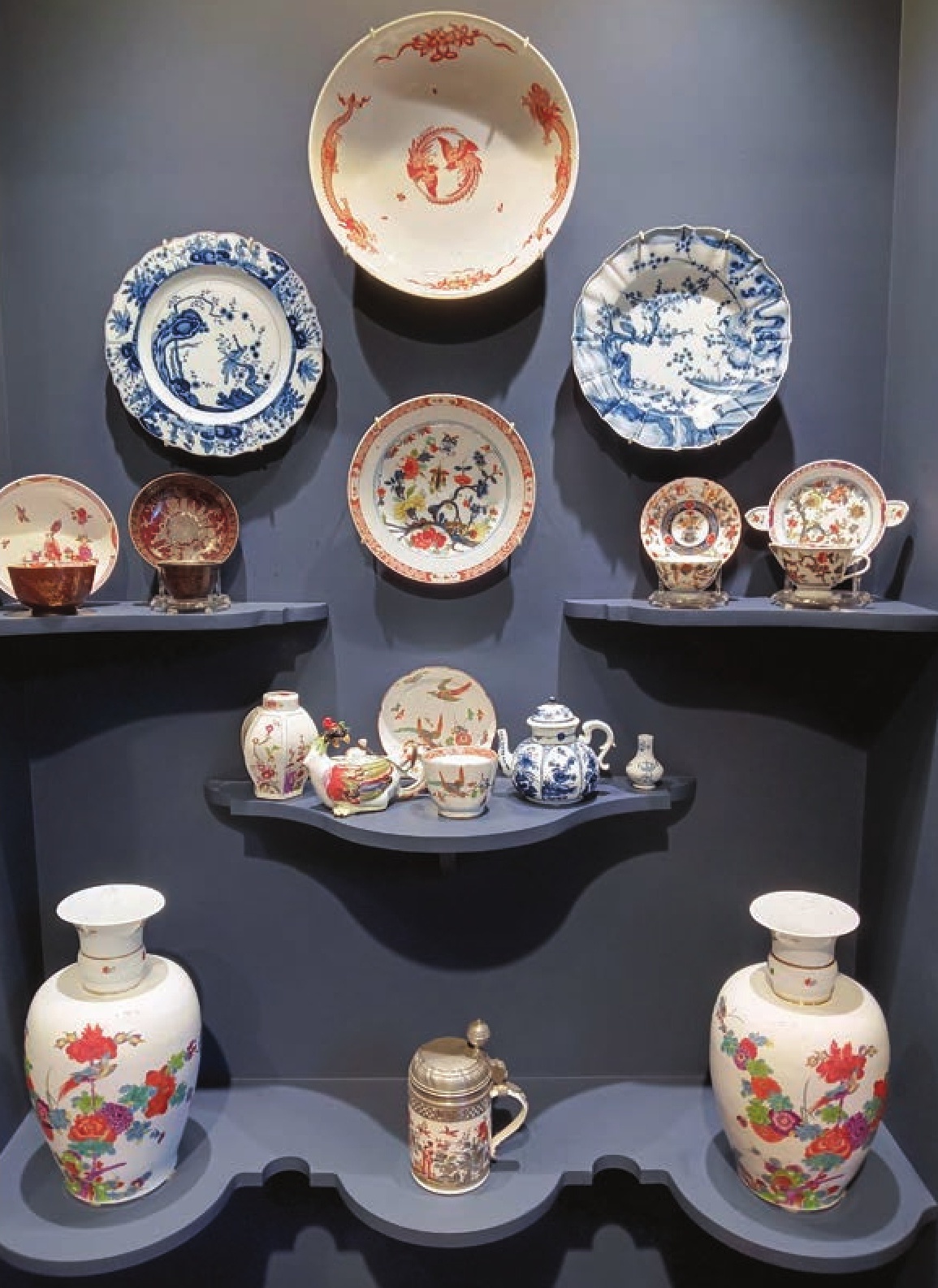
Europe’s first porcelain manufacturer, Meissen, founded in 1710 in the town of Meissen, Germany, dominated porcelain-making in Europe for many years. It was located 16 miles northwest of Dresden in Saxony, a German state that borders Poland. Augustus the Strong, the ruler of Saxony and King of Poland, had a passion for porcelain that was so intense, he acquired Dresden’s so-called Japanese Palace in 1717 to house his collection of 20,000 to 30,000 porcelain items made in China and Japan. Because a cobalt blue–and-white underglaze was one of his favorite Asian porcelain styles, Augustus offered a prize to anyone who could invent a process to imitate it, after other European countries tried and failed. Meissen won the prize in 1720 with a recipe that used kaolin and porcelain stone (petuntse) and ground feldspar.
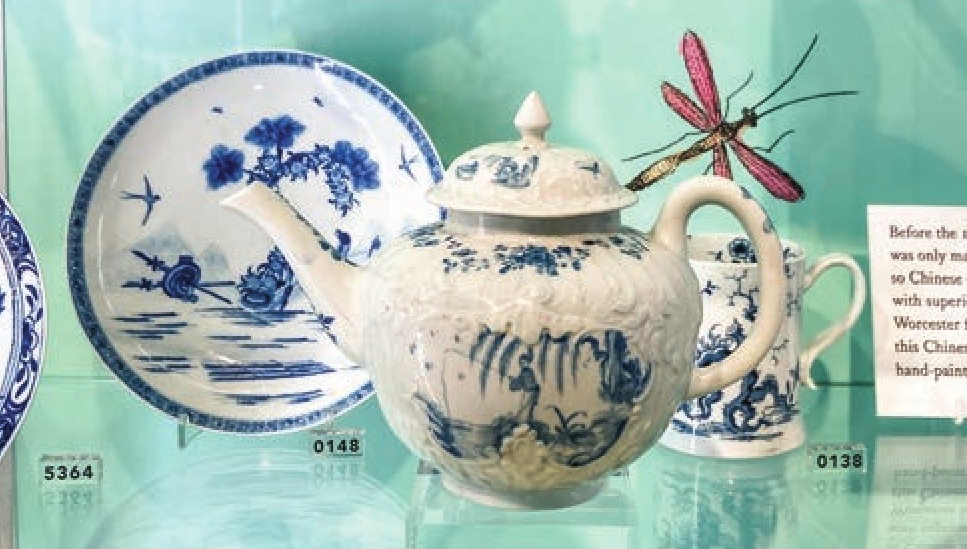
Meissen continued making blue-and-white porcelain, echoing China’s flower and animal themes along with other chinoiserie styles, throughout the 18th century. Other porcelain manufactories opened in Vienna (Du Paquier, founded by a Dutchman in 1719), Munich (Nymphenburg in 1747), and Berlin (KPM in 1763). Johann Gregorius Höroldt, trained as a wallpaper painter and tapestry designer, came to Meissen from Vienna in 1720. He served as its leading porcelain painter for more than 50 years and developed 16 new enamel colors that are still in use today. His more than 1,000 drawings, inspired by illustrations and prints of East Asia in late-17th-century travel books plus his own imagination, were compiled into a workbook in 1723–4 for Meissen artisans to follow. He is widely considered the progenitor of European chinoiserie.
A wonderful collection of chinoiserie teaware, featuring examples from every major 18th-century German porcelain maker plus British manufacturers, can be seen at the Dixon Gallery & Gardens in Memphis, a museum that owns one of the largest porcelain collections in the United States. More than 600 objects (teapots, cups, saucers, plates, and vases) are in its Warda Stevens Stout Collection, assembled over the course of 40 years by the wife of Dixie Portland Flour Company founder Charles Stout. Her love for antiques began with childhood trips to New Orleans antiques shops with her mother, starting with English and French porcelain in the 1930s and then focusing on German porcelain in the 1940s. Höroldt’s “adaptation of East Asian scenes spawned an entirely new and distinctive style of chinoiserie”—boldly multicolored, highly decorative, often featuring Chinese people tea-drinking or enjoying other leisure pastimes—the Dixon exhibit notes.
Later in the 18th century, Sèvres in France and England’s Royal Worcester and Caughley Pottery Works (where Thomas Minton created Blue Willow in the 1780s) followed with chinoiserie teaware patterns. “The Blue Willow pattern is the most popular pattern in design history,” says Bertram, who now lives in Charleston.
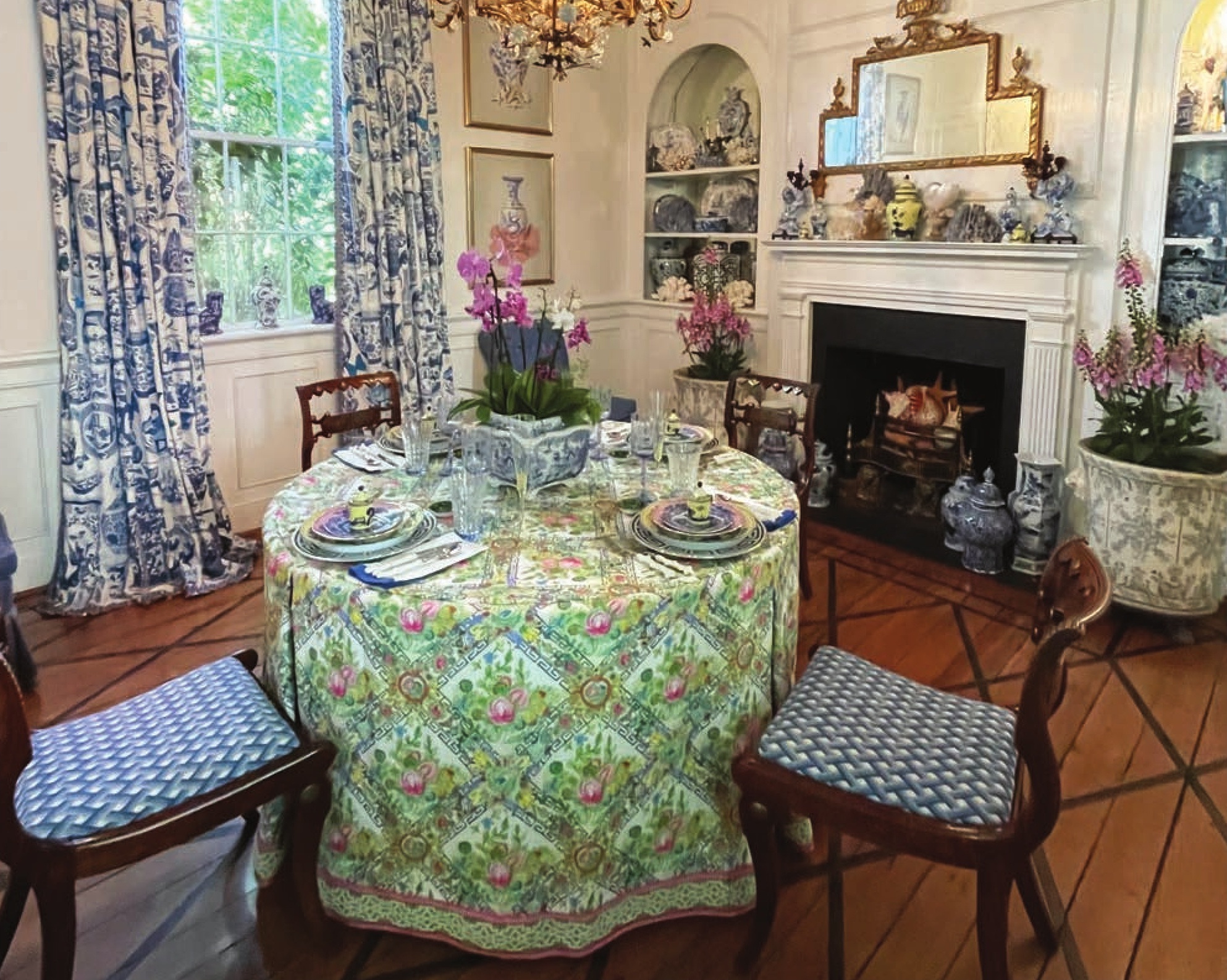
Erika Wallace, an interior designer with Stone Ridge Interiors/Island Architects in Charleston, decorated her dining room in blue and white to match her chinoiserie teaware. “I had a collection of various chinoiserie china patterns, some in blue and white, and it all just sort of evolved from there. The inspiration was the history of my home, built in 1817 during the Barbados trading era in Charleston. That brought in the influence of British imports such as blue-and-white porcelain, which became a status symbol in Charleston in the early 19th century.”
She uses a wide variety of china patterns in her dining room. “But my favorite is Oriente Italiano, a chinoiserie pattern made by Ginori 1735, an Italian porcelain maker near Florence, that comes in multiple colors and can be mixed and matched,” says Wallace. But she’s not wedded to blue and white. “Blue and white can be accented with any color. [In autumn], I have a lot of orange in the room. At Christmas, it will be red tartans,” explains Wallace, who changes the room seasonally.
For almost 1,000 years, China produced blue-and-white porcelains envied worldwide, inspiring potteries to imitate this style and add their own twists. Its legacy survives in the very word, china—and its power to enchant remains today.
Sharon McDonnell is a travel, culture, food, and drink writer who has visited China several times.